
Thank you.
You already do the hard part. You read the studies, check the sources, and explain them to people who never asked for a lecture but deserved a straight answer. For many of us it happens after a full day of other work, and it's rarely thanked. This map exists so more people can find you.
Curiosity100
Why we point to each other
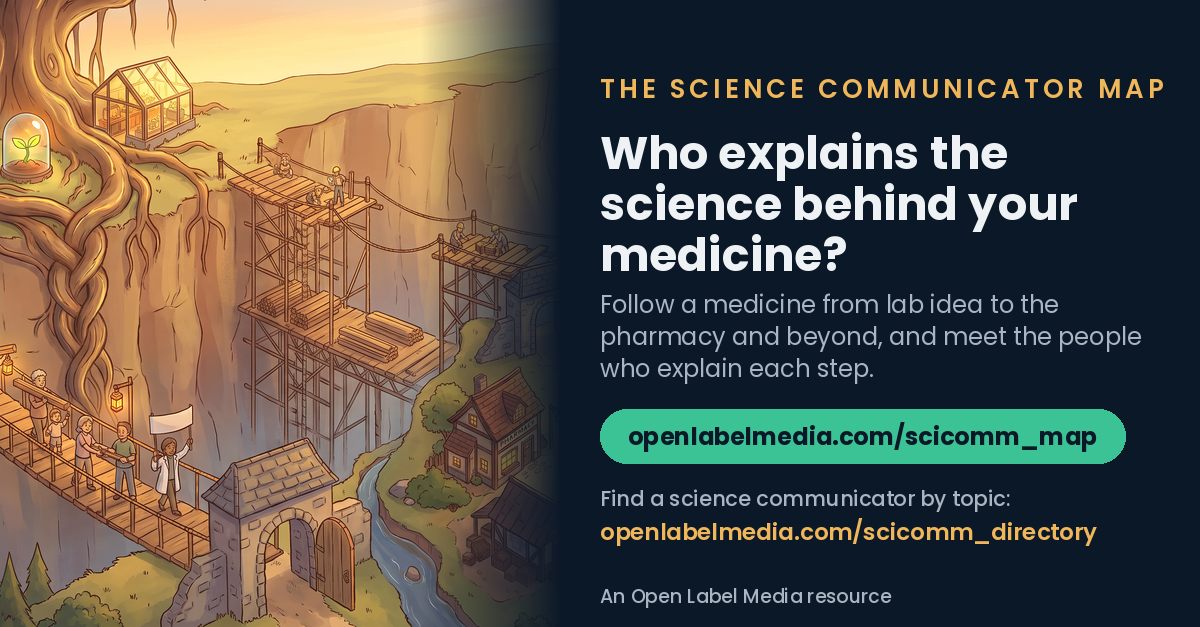
Every medicine travels a long road, from a lab idea to the pharmacy and beyond. The map pins real people to each stretch of that road, so the public can find someone who explains the part they're asking about.
Same people. Connected, a person with a question can reach the right one.
Take back skepticism
Somewhere along the way, the word skeptic got stolen. It was handed to people who doubt everything except the person selling them an answer.
It got bad enough that skeptics themselves objected. In December 2014, fellows of the Committee for Skeptical Inquiry, including Bill Nye, signed an open letter asking journalists to stop calling climate deniers "skeptics." The next September, the Associated Press told its reporters to avoid both "skeptics" and "deniers," and to write "doubters" or "those who reject mainstream climate science" instead.
The result: the people rejecting the evidence got a gentler label, and the word skeptic was set aside instead of handed back. Phrases like "vaccine skeptic" still show up in headlines.
On this map we skip "healthy skepticism." Skepticism already means checking, so it doesn't need the qualifier. Doubting everything is cynicism. Deciding before looking is denial.
Four ways to meet a claim.
Sources: the Committee for Skeptical Inquiry open letter, via NCSE, December 2014; Poynter on the AP guidance, September 2015.
What we're aiming for
A seat on the map is not an endorsement of every other member, and nobody on the map speaks for anyone else. What we share is a standard, not a script.
Being part of the catalyst
In chemistry, a catalyst doesn't do the reaction for you. It lowers the energy it takes to get started, and it isn't used up, so the same reaction can happen again and again.
That's the job here. One careful post is a spark. A network of people who send readers to each other makes it easier for good information to keep moving, long after any single post is gone. You don't need to post more. You just need to stay connected. The idea isn't everyone saying the same thing. It's everyone pointing to each other.
Same question, same answer. The map lowers the hill in between.
- You share your profile or a card.
- Your followers see the whole road.
- They meet members on other stretches.
- Someone with a question finds the right person. Repeat.
Every share sends people past other members' cards.
The people on the map
These are the people you're joining. Tap anyone to open their card.
See everyone in the directory, sorted by profession and topic.
Ways to use the map
Every one of these is optional. Pick what fits how you already work: no posting quota, no exclusivity, and you keep your own brand.
- Open your profile link and check your name, role, bio, photo and every link: openlabelmedia.com/scicomm_map/?m=your-id
- Add the map link to your posts, so followers can explore the rest of the science pipeline: openlabelmedia.com/scicomm_map
- Add your profile link to your link in bio, newsletter footer or website.
- Save the directory for replies when a question isn't yours: openlabelmedia.com/scicomm_directory
- Share your card once, using the buttons below or the Download share graphic button on your profile.
- Reply to your welcome email with any fixes. They go live with the weekly update, by the end of Sunday.
Your tools
| Tool | What it is |
|---|---|
| Your profile | A card with your bio, what people can ask you about, your best post for newcomers, and your links. |
| Your profile link | openlabelmedia.com/scicomm_map/?m=your-id opens the map straight to your card. |
| Your share graphic | An "I'm on the map" image with your name, photo and your part of the map, from the Download share graphic button on your profile. |
| The directory | Everyone on the map, sorted by profession and topic. Your answer when a question isn't yours. |
| Also on the map | Your neighbors on the road, listed on your card. Their audience is one step from yours. |
| Open to collabs | A tag on your card if you said yes. Expect friendly notes from other members, and send some too. |
| Spotlights | Root to Rx may feature members from time to time. A reshare helps, but it's never required. |
| Your numbers | Once site analytics are running, a short monthly note with how many people opened your card and clicked your links. |
Share the map in one tap
Cards anyone can post
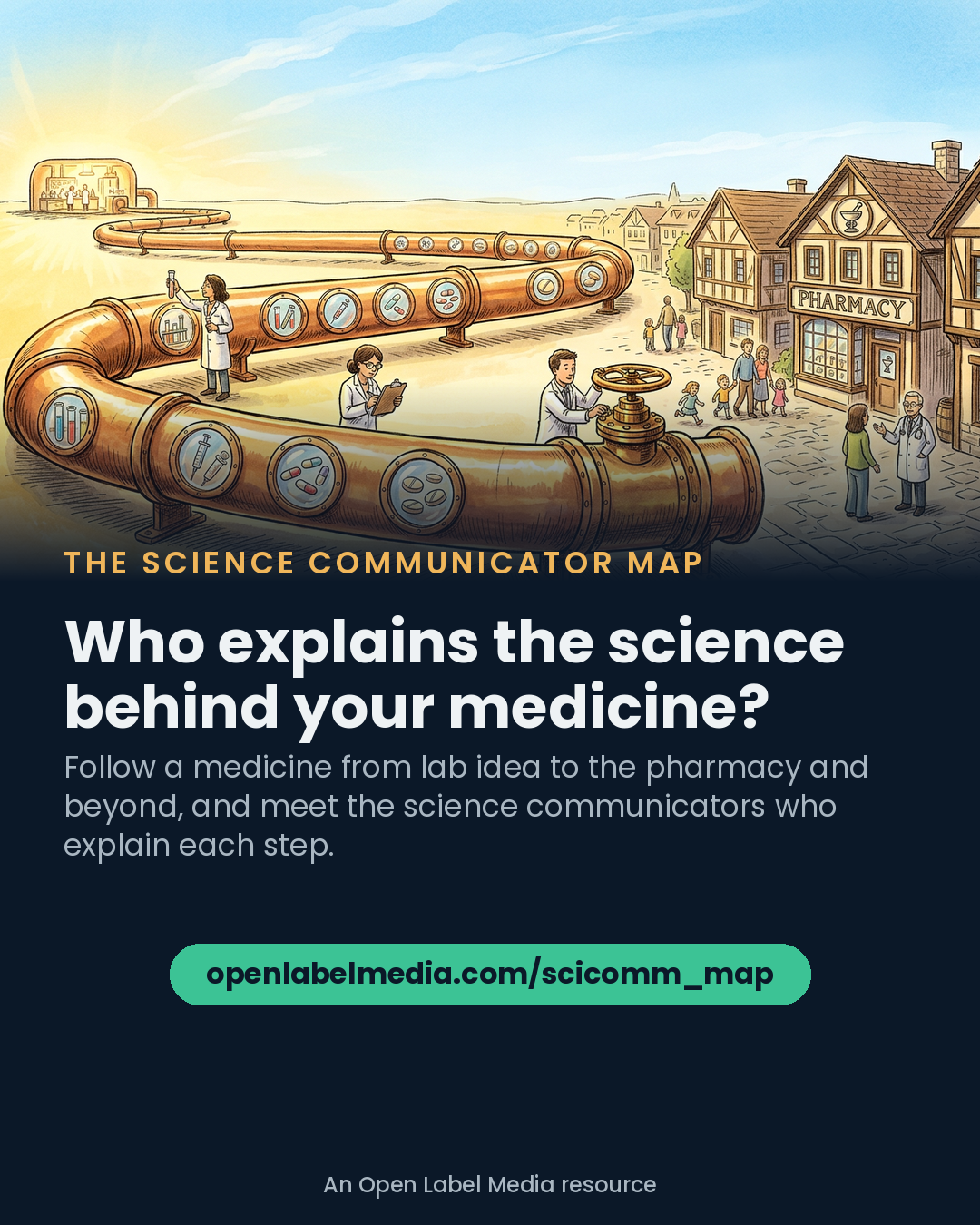 The map (4:5)
Card coming soonThe map (4:5)
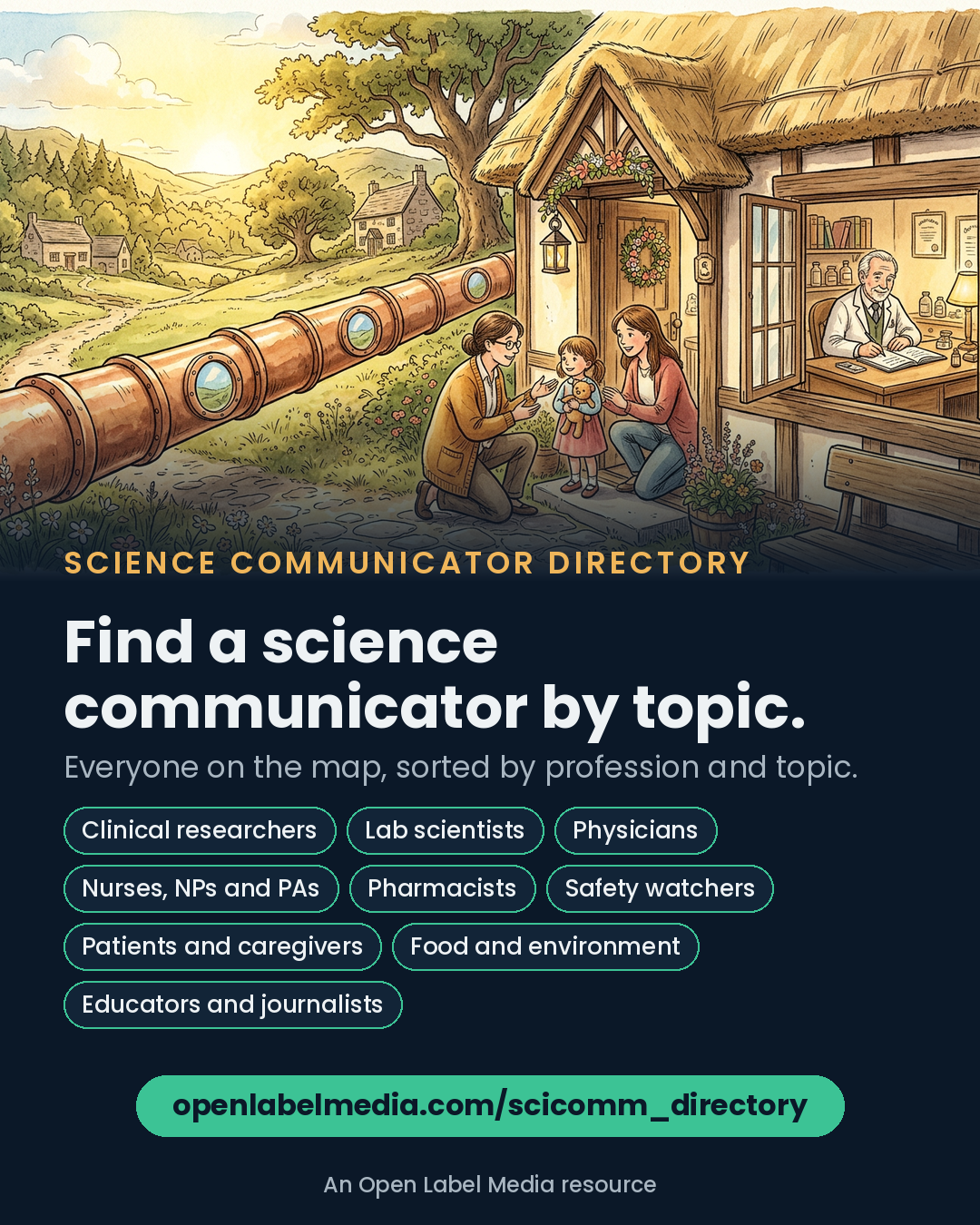 The directory (4:5)
Card coming soonThe directory (4:5)
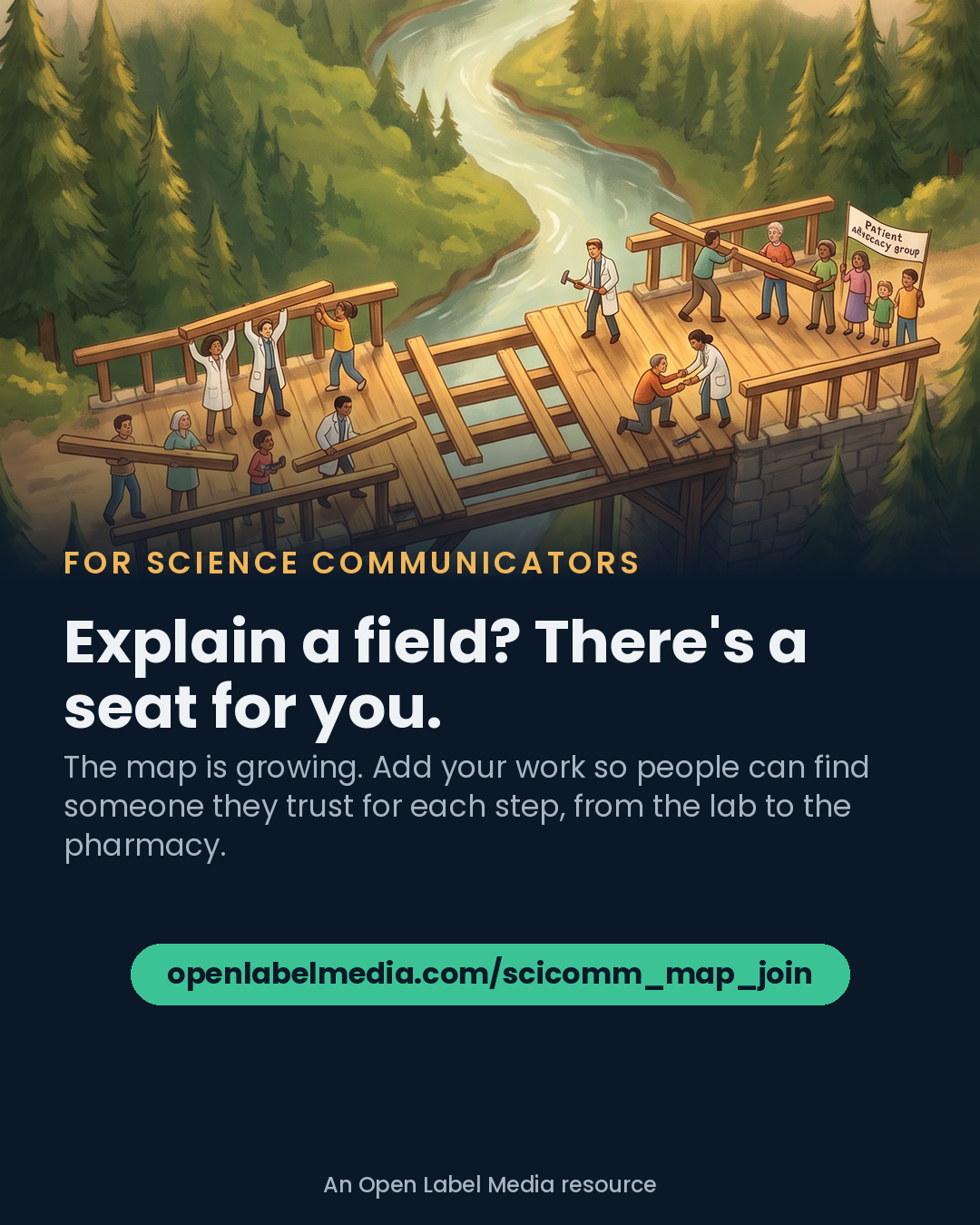 Join the map (4:5)
Card coming soonJoin the map (4:5)
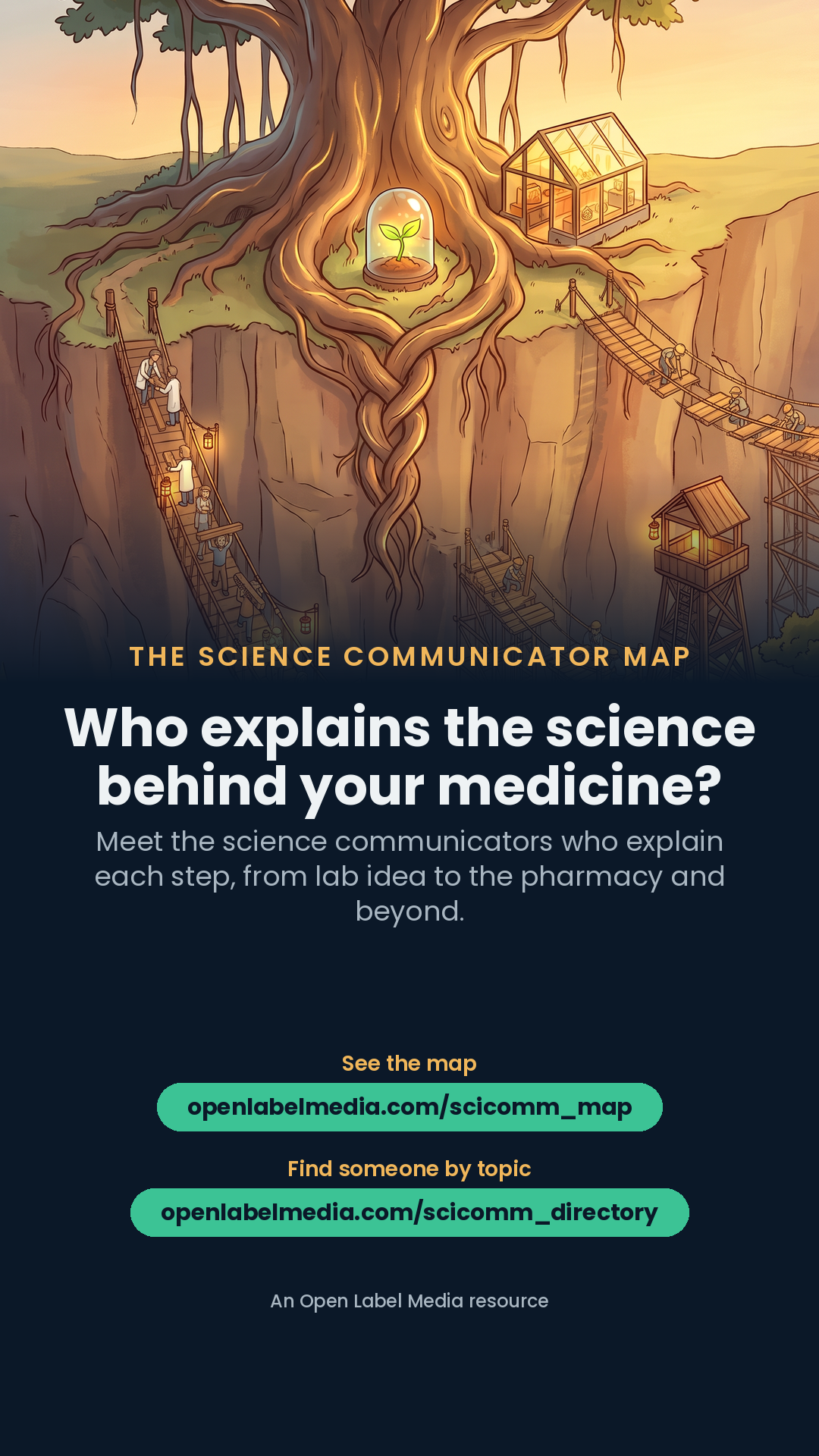 Story (9:16)
Card coming soonStory (9:16)
 LinkedIn (1200 x 627)
Card coming soonLinkedIn (1200 x 627)
Captions you can copy
They work best in your own words. Change anything.
If it helps: posting step by step
Instagram Story. Add the Story card to your Story, tap the sticker icon, choose Link, paste your profile link, and place the sticker in the empty space in the middle of the card.
LinkedIn. Attach the LinkedIn card, paste the LinkedIn caption, and put the link in the first comment. Many creators do this because LinkedIn may show posts with links in the body to fewer people.
Things to hand your followers
Point people to each other first, then to tools that help them check claims on their own.
From the people on the map
From outside the map
A few free tools from Root to Rx
Supporting each other
Nobody takes skepticism back alone. The map works best when we show up for each other, as one network instead of a hundred separate voices. A few ideas:
Talking with people, with each other, and with yourself
Some of what helps here has been tested in studies. Some is practical wisdom from people who teach hard conversations for a living. Each is labeled, so you know which is which.
With someone who believes a bad claim
Practice tools for this: the OPEN and PAUSE cards in Stay in the Room, and Adam Grant's Think Again.
With each other
With yourself
This work costs something. If you're tired, pile-on weary or second-guessing yourself, you're not the only one. Reach out to another member, or to me.
You may know this better than I do
These findings shape how the map works. If you see something I've gotten wrong, email me and I'll fix it, with credit.
Prebunking builds resistance
Short videos explaining manipulation tricks, run as real YouTube ads, helped viewers recognize those tricks later.
What this suggests for us: teach the tricks, not just the facts.
Corrections usually don't backfire
Across dozens of claims, people generally moved toward the facts after a correction, even on politically loaded topics.
What this suggests for us: keep correcting, kindly.
Lead with the fact, not the myth
Debunking researchers recommend an order: the fact, a warning before the myth (mentioned once), the fallacy behind it, then the fact again.
What this suggests for us: the fact gets the headline. The myth gets one labeled mention.
A lot of bad sharing is inattention
In some experiments, a simple prompt to think about accuracy improved the quality of what people went on to share.
What this suggests for us: assume people are busy, not foolish, and ask "how do we know?" out loud.
Cynicism isn't a sign of smarts
People tend to assume cynics are more competent. When researchers checked, cynics (here meaning people with a general distrust of others' motives) actually scored lower on tests of cognitive ability and competence.
What this suggests for us: show the checking, not the doubt.
Technical words can stand in for evidence
In a well known study, people rated poor explanations as more satisfying when irrelevant neuroscience language was added. Researchers still debate how large the effect is.
What this suggests for us: if a claim needs jargon to sound convincing, look closer, including at our own posts.
The standards we share
Members don't sell or promote treatments, supplements or clinics that lack trial evidence. Getting paid for good science content is fine.
You agreed to these when you joined (Participation Terms v1.0). They're what make a seat worth something, for you and for everyone beside you.
- Cite primary sources.
- Disclose conflicts of interest.
- Correct mistakes in public.
- Stay in your lane, and point people to others outside it.
- Earning from your content is fine. Sponsors, affiliate links, books, courses and gear are welcome. Disclose them, and keep them to products that don't make health claims the evidence hasn't backed.
- Don't sell or promote treatments, supplements or clinics that lack trial evidence, even ones you've tried yourself. Patients and caregivers: your own story is always welcome; promoting an unproven path is not.
- Never share confidential information from your employer, patients or anyone else. I will never ask for it.
If something ever falls short, I'll reach out privately first. You can leave anytime, no questions asked.
Standing on good shoulders
Root to Rx's Sunday letters column, The Roots, ends every issue with a banyan tree. A banyan grows by dropping roots from its branches, and each root becomes a new trunk. Every person who knows how the science works can be one of those roots. Misinformation has been taking root faster than we have. The map is what it looks like when the trunks find each other.
The method is older than any of us. Carl Sagan's The Demon-Haunted World gave readers a "baloney detection kit," and the Skeptic's Toolkit carries that tradition forward. The books behind our thinking, from Sagan to Crucial Conversations, are listed on Behind the Label.
Who's coordinating this
I'm Justin Yamashita. I got into clinical research through my first job as a clinical trial coordinator, and today I'm a clinical trial project manager. In my day job I coordinate large trial teams, and every one of them runs on a team list. The map is our team list. I'm the coordinator, not the expert. The expertise is yours.
Keeping your card current
| If you want to | Do this |
|---|---|
| Change a link, bio, photo or best post | Email justin@openlabelmedia.com. Changes go live by the end of Sunday. |
| Turn Open to collabs on or off | Same email. |
| Leave the map | Same email. You come off at the next weekly update. |
| Raise a concern about a listing | Same email. It stays private. |
| Suggest a new member | Send them the join page. |
Five things to remember
The map gives them one place to find the right person for the right question.
Referrals are the catalyst.
Skepticism means checking, not doubting everything.
Cite, disclose, correct in public, stay in your lane, sell no certainty.
Use the map in whatever way fits how you already work.
Thank you for reading the paper instead of the headline. Thank you for saying "we don't know yet" when that's the honest answer. Thank you for the comments you answered kindly when it would have been easier to scroll past, and for explaining your corner of the road so the rest of us can see it.
I've spent years inside clinical research watching how much care goes into getting a medicine to people safely, and how little of that story reaches them. You're how it reaches them.
Let's take skepticism back, together. And if you have suggestions or questions, email me. I'm still learning.
Version 1.0, November 2026. Members shape version 2. Changes will be listed here, with credit to whoever suggested them.